
Not long ago, the question surrounding artificial intelligence was whether it was worth using at all. Today, that conversation has changed completely. AI has moved beyond being a novelty. It’s becoming another business tool, much like your CRM, accounting software, project management platform, or development environment.
That’s real progress.
It also means we’re entering a new phase, one that I didn’t expect.
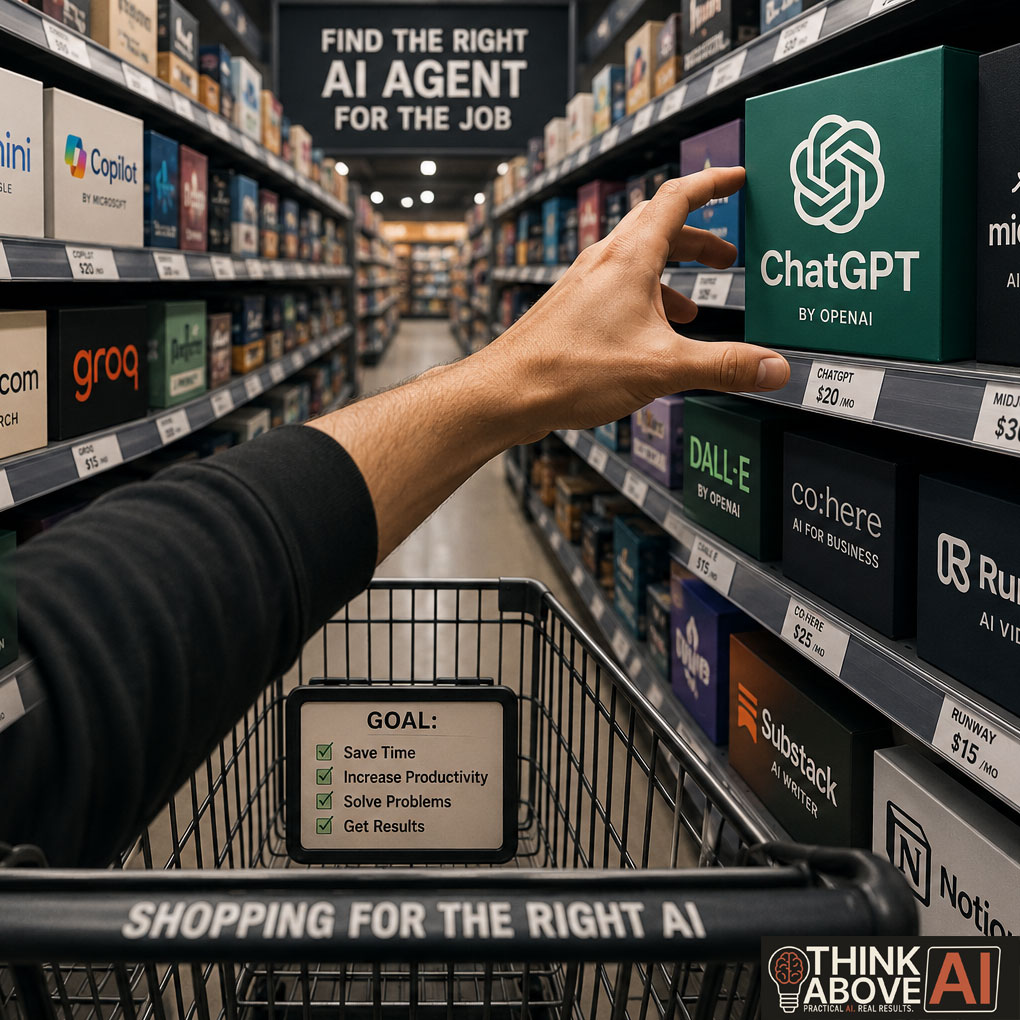
I’ve started shopping for AI agents.
Not because I’m fascinated by every new release, but because I’m looking for the right tool for the work I do every day. As someone who has integrated AI throughout my own business and now helps other businesses adopt it, I spend a significant amount of time evaluating different platforms against the same tasks. I feed them development problems, technical documentation, large research projects, marketing strategies, legal summaries, and operational planning. Then I compare the results.
The winner isn’t always who the headlines say it should be.
What I’ve noticed over the past year is that many AI companies seem to be chasing the same goal, and I’m not convinced it’s the right one.
Somewhere along the way, AI assistants stopped trying to become the best productivity tools and started trying to become the best personalities.
That’s an important distinction.
When I open an AI platform during my workday, I’m usually in the middle of solving a problem. I have code to review, documentation to write, a client issue to research, or data to analyze. I’m not opening the application because I’m looking for conversation. I’m opening it because I have work to accomplish.
Yet I’ve found myself repeatedly redirecting AI back to the task.
Instead of immediately solving the problem, many platforms seem increasingly interested in extending the conversation. They ask additional personal questions that don’t improve the outcome. They spend time building rapport when they should be building the solution. Some even begin anticipating emotional needs before they’ve addressed the business need sitting directly in front of them.
Friendly software isn’t the problem.
Losing sight of the purpose is.
Businesses are investing in AI because they expect measurable gains in productivity. They want to automate repetitive work, accelerate research, improve customer response times, reduce administrative overhead, and help employees accomplish more in less time. That’s where AI has the potential to create enormous value.
That’s also why I believe the market is beginning to shift.
The excitement surrounding AI hasn’t disappeared, but businesses are becoming far more practical. The questions are changing. Instead of asking which model scored highest on a benchmark, business owners are asking which platform consistently helps their team work faster, produce better results, and save time every single day.
Those are very different conversations.
Industry analysts are seeing the same transition. Gartner recently warned that many so-called “agentic AI” projects are unlikely to deliver meaningful business value because expectations have exceeded practical implementation. At the same time, organizations continue increasing AI investments, but with greater emphasis on measurable return, operational efficiency, and task-specific outcomes rather than novelty alone. Those trends suggest the market is beginning to separate useful tools from impressive demonstrations.
That mirrors my own experience almost perfectly.
I’ve tested platforms that produced beautiful demonstrations but struggled with real development work. I’ve used others that weren’t flashy at all, yet quietly became part of my daily workflow because they consistently solved problems without creating new ones. After enough testing, benchmark scores become less interesting than reliability. The AI that consistently completes difficult work without unnecessary conversation almost always becomes the one I continue paying for.
Maybe that’s simply the next stage of AI.
The first generation proved the technology could work. The next generation will prove which companies truly understand why people opened the application in the first place.
For me, the answer has never changed.
I’m not looking for another friend.
I’m looking for another productive member of my team.
Over the coming weeks, I’ll be publishing a series on practical AI implementation from the perspective of someone who uses these tools every day for real client work. I’ll be comparing AI agents, documenting where they excel, where they fall short, and sharing the workflows that genuinely improve productivity. There won’t be rankings based on hype or marketing. There will be real testing, real business scenarios, and honest evaluations based on one question:
Does this AI help me get better work done?
In the end, that’s the only metric that really matters.
We help businesses streamline processes, become more productive and implement AI solutions that delivers measurable results.
Share This Article
More Insights