Both are lazy takes.
AI myths for small business keep owners stuck in hesitation. Some people think AI is expensive, risky, or only for big companies. The truth is more practical.
The truth is simpler. AI can help small businesses a lot, but only when it is used for the right jobs, with the right guardrails, and with realistic expectations.
If you are a small business owner, service company, agency, or growing team, this matters now. AI adoption is not some distant trend. The U.S. Chamber of Commerce reported that 58% of small businesses say they use generative AI in 2025, up from 40% in 2024 and 23% in 2023.
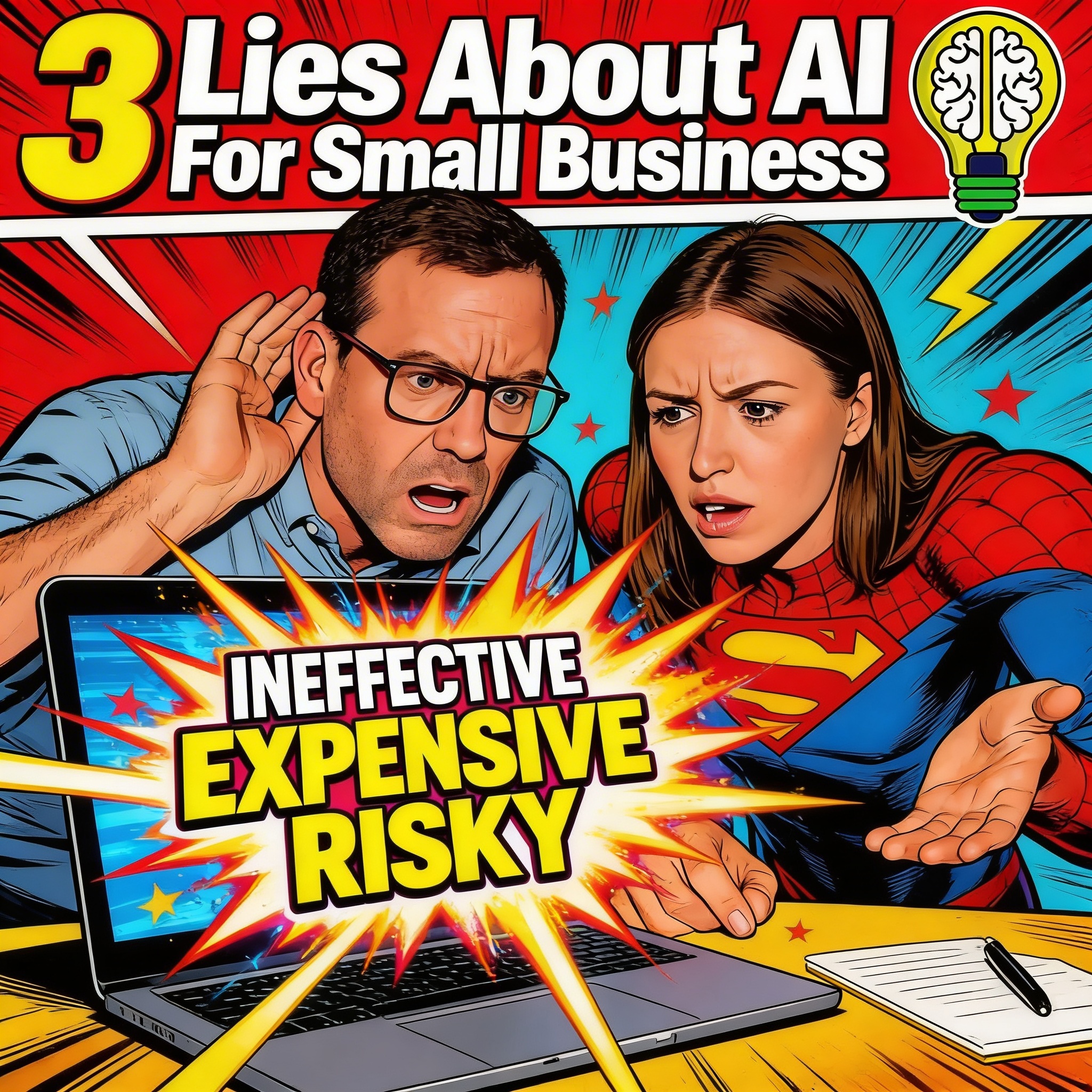
Here are three of the biggest myths holding small businesses back, and what is actually true.
This is the fear most people start with, and honestly, it makes sense. The headlines are dramatic because drama gets clicks.
For most small businesses, AI is not replacing teams. It is helping teams handle repetitive work faster.
Recent small business data from Gusto shows early evidence that businesses with more AI-exposed work are seeing revenue and hiring gains, not broad job losses. Their analysis of payroll data across 400,000+ businesses found no evidence of overall job losses from AI in small businesses, and in some cases slightly more hiring.
The U.S. Chamber’s 2025 report also found that 82% of small businesses using AI increased their workforce over the past year.
That does not mean there are no changes. There are. Gusto also notes that entry-level roles in highly AI-exposed jobs can feel pressure, and employers may expect stronger judgment and tool usage from new hires.
AI is best used to remove low-value tasks, not remove valuable people.
Use AI to support your team with things like:
Your people still handle judgment, approvals, relationships, and accountability. You know, the parts customers actually care about.
This myth sticks around because AI sounds like something that requires a full IT department, a data scientist, and a budget meeting nobody survives.
Small and mid-sized businesses are already adopting AI, and many are doing it in practical ways.
Salesforce’s SMB Trends research (based on 3,350 SMB leaders globally) found that 75% of SMBs are investing in AI in some capacity, and over a third say they have fully implemented AI in their operations. The report also notes growing SMBs are 1.8x more likely to invest in AI than declining SMBs.
The U.S. Chamber’s 2024 and 2025 reporting also shows AI use growing fast among small businesses, alongside broader technology adoption.
Most small businesses are not building custom models. They are using AI features inside tools they already pay for, or adding affordable tools to solve specific workflow problems.
You do not need a giant AI project. Start with one bottleneck.
Good starting points:
The goal is not “become an AI company.”
The goal is “stop wasting time on work that should be automated.”
That is a much better use of your money and your blood pressure.
This one is half true, which makes it more dangerous than a full myth.
Yes, AI can be wrong. It can produce bad outputs, inconsistent answers, and confident nonsense if you use it carelessly.
AI does carry real risks, but that does not make it unusable. It means you need process, review, and boundaries.
NIST’s AI Risk Management Framework exists for exactly this reason. It emphasizes managing risks such as privacy, security, reliability, and accountability when organizations design, deploy, or use AI systems.
In plain English: do not let AI run wild in areas where mistakes cost you money, trust, or legal problems.
Use AI where it is strong, and review where accuracy matters.
A smart approach looks like this:
Use AI for first drafts and speed
Require human review for final decisions
Set simple guardrails
AI is not “too risky” for business.
Unmanaged AI is risky. Big difference.
AI is not magic.
AI is not a scam.
AI is not a replacement for leadership.
It is a tool. A very useful one, when applied to the right tasks.
The businesses getting results are not chasing every shiny feature. They are using AI to improve speed, consistency, and follow-through in areas that already matter:
That is why the conversation should shift from:
“Is AI good or bad for small business?”
to:
“Where is my business losing time, and which parts can AI help us fix safely?”
That is the question that leads to actual results.
If you are unsure whether AI makes sense for your business, start with one rule:
Pick one repeat problem.
Not ten. One.
Then test AI on that process for 2 to 4 weeks and measure:
Small businesses do not need hype.
They need practical wins.
That is where AI proves itself.
At Think Above AI, we help small businesses use AI in practical ways that improve operations, marketing, and communication without creating chaos.
If you want to find the best place to start, take the free assessment and we’ll point you toward the right next steps for your business.
Get a Free AI Assessment
Find the fastest way AI can save you time and improve your workflow. We’ll review your goals, spot quick wins, and map a simple plan you can actually implement. No pressure, no commitment. Just clarity.